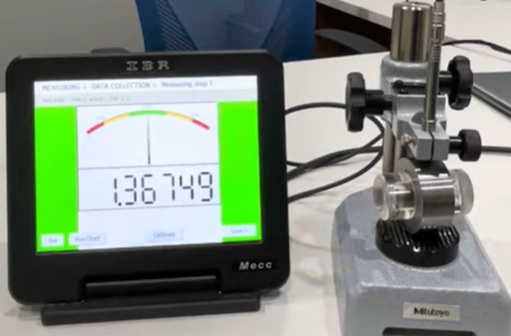
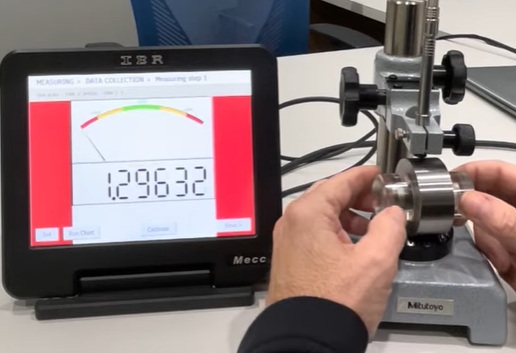
Compact measuring computer with 8″ TFT touch display, power supply, Windows Embedded compact 7 operating system and ComGage level 1
IBR MECC LITERATURE
ISi-Bus connection cable, radial, length 1 m
Inductive measuring probe with free of clearance ball bearing, integrated signal
processing and ISi-Bus interface, measuring range 5 mm, axially pluggable
CD43 video
IBR Mecc Compact Readout Paired with IMS Probes Is Ideal for Measuring Bearing OD
When it comes to precision manufacturing, measuring bearing outside diameters (OD) demands tools that deliver speed, stability, and trustworthy accuracy. Bearings are mission-critical components, and even slight deviations in OD can impact performance, noise levels, load capacity, and lifespan. That’s why metrology shops, bearing manufacturers, and precision machining operations increasingly rely on the IBR Mecc compact readout combined with IMS inductive probes.
Together, these two technologies create a compact, flexible, and highly accurate measurement system that excels specifically in bearing OD applications. Here’s why this pairing stands out.
- Exceptional Responsiveness for Real-Time OD Measurement
Bearing OD checks often happen in fast-paced environments—production cells, SPC sampling stations, or even in automated gauging setups. Measurement lag or unstable readings slow everything down.
The IBR Mecc readout is engineered for extremely fast sample rates, allowing it to:
- Capture rapid dimensional changes during part rotation
- Stabilize readings quickly, even with small OD variations
- Support dynamic measurement methods such as snap gages or air-to-contact transitions
Paired with IMS probes, which are known for high-bandwidth and low-latency signal generation, the system offers instantaneous feedback—ideal for operators who need a reading right now, not five seconds later.
This responsiveness means less waiting, less rechecking, and ultimately higher throughput without sacrificing quality.
- Accuracy Maintained Across the Entire Probe Range
One of the standout advantages of IMS inductive probes is their linearity and accuracy across the full measurement range.
Unlike lower-end probes that produce excellent accuracy near mid-range but drift near travel limits, IMS probes provide: