



AI-Based Visual Quality Inspection
This system uses artificial intelligence (AI) and machine learning algorithms to “learn” and find true defects.
Here is what differentiates this system from the rest:
- Auto programming
- Auto lighting
- Auto path
- Auto learning optimal approach for defect
- True AI with 10,000 stored images
- Second sensor to quantify defects
AI software rapidly learns the defects and anomalies in your parts, discerning between acceptable tolerances and true defects. Leveraging its AI processing engine, combined with optimal sensors, magnification, positioning, and lighting, Kitov AI helps you eliminate existing defects and maintain process control. Defects are detected through image analysis and can be compared to CAD or a golden part, which can be easily edited in offline software like Photoshop
Ready-to-use visual inspection solution that combines traditional machine vision techniques, including automated lighting control, deep learning, 2D/3D imaging, and intelligent robotic planning. 3D views, could be trained in part identification, and used AI and deep learning algorithms to learn to find even the smallest irregularities. detect all defects or without a system without sensitivity to reflection.
Ability to use different sensors – optics, laser, surface analysis
Read More
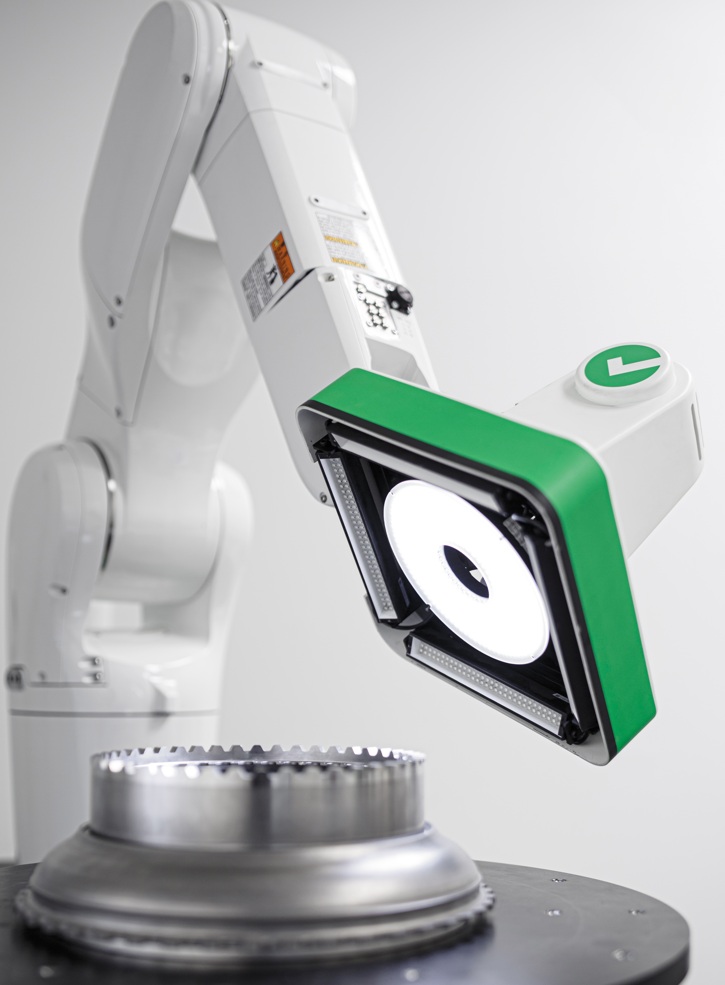
A camera mounted on a robotic arm takes images of the part from all angles, eliminating the need for expensive fixed cameras. The camera has multiple lighting elements to capture different types of materials and shapes, while the robotic arm allows for inspection from all angles, without the need to rotate parts on the line.
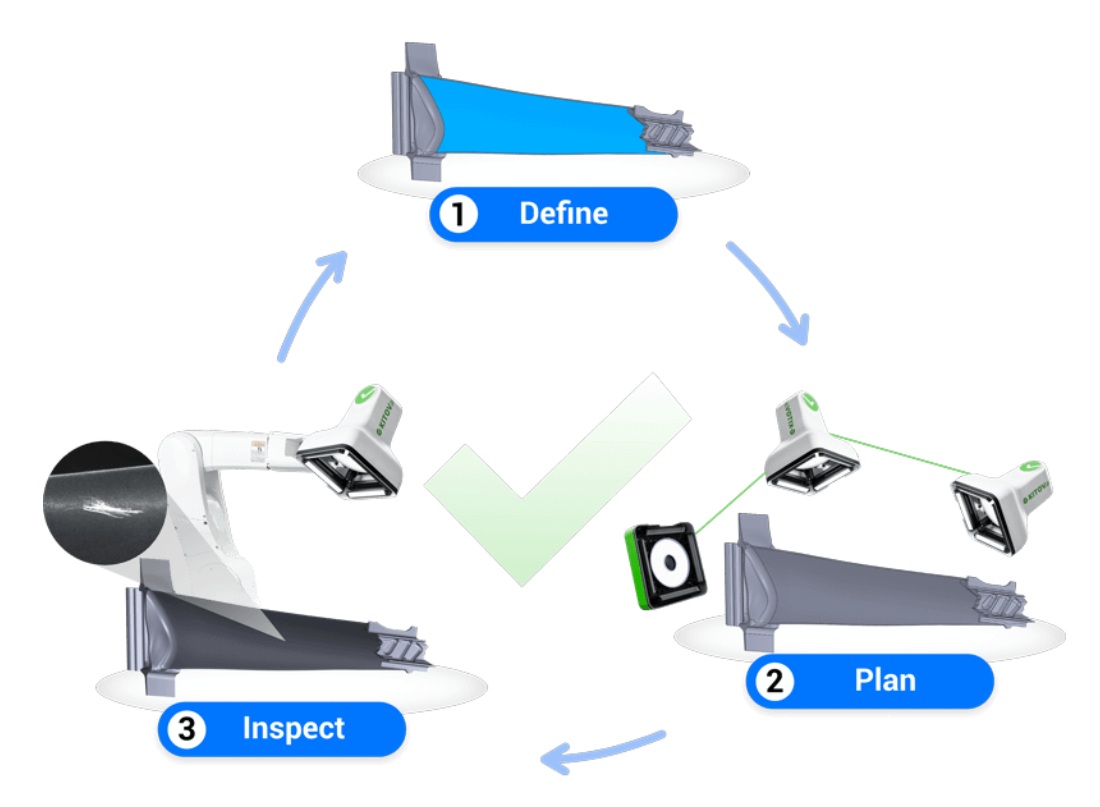
Inspection of parts requires dozens of images, and it is extremely hard to define an inspection plan and to grab these images. With the Kitov Smart Planner, the machine vision and robotic motion program is made automatically. With Kitov-CorePlus, a customer-trained engineer can create an inspection plan for a product with a CAD file or a full 3D scan. By imitating human learning processes, Kitov-CorePlus learns intuitively how to best inspect a product. The automated system can inspect parts of different sizes and can easily and quickly move between inspection plans.
On the software side, the technology uses traditional machine vision algorithms, semantic detectors (pretrained neural networks), and AI and deep learning to identify flaws and to continuously improve its flaw-finding capabilities. The machine vision process involves image acquisition and defect detection and classification. This is a fast, accurate, and low-cost way to identify defects and anomalies. The system discerns parts based on color, geometry, and material. Deep learning takes these features to the next level to identify abstract part attributes, such as surfaces and edges.
With deep learning, an expert trains software using images of “good” and “bad” parts. The software then analyzes the images for features and relationships between features. AI helps deep learning improve on analysis over time, just as humans get better at their jobs over time. Kitov.ai is constantly developing and adding new pretrained neural networks.
Because Kitov-CorePlus uses semantic segmentation and deep learning to differentiate between different types of defects, such as scratches and oil smudges, the system eliminates the identification of false defects. This innovative technology gives the manufacturer the ability to group inspection locations and to carry out multiple inspections in a single field of view.
Kitov.ai’s inspection system comprises an off-the-shelf CMOS camera with multiple brightfield and darkfield lighting elements in a photometric inspection configuration to capture 2D images. Proprietary software combines these images into a single 3D image. The technology uses common semantic terms (“screw,” “port,” “label,” “barcode,” “surface”) rather than machine vision programming terms (“blob,” “threshold,” “pixel,” “contrast”), helping nonexperts learn how to modify or create new inspection plans in a short time.
Kitov.ai’s intelligent robot planner uses mathematical algorithms to automatically maneuver a robot with a sensor head, without the need for operator input. The algorithms dictate where the camera moves, choose an illumination condition from a set of onboard lighting elements, and determine how many images to capture for each test point. Additionally, the software instructs the robot how to move optimally from point to point during inspection. After acquisition of data, Kitov.ai’s deep learning software classifies potential defects discovered by 3D machine vision algorithms.